Friday, June 17, 2011

Impressions, Impressionists and Others

I'm a big fan of the Impressionistic era art though Henri Matisse (post impressionist movement) is my fav, fav, favorite though there are others I more than appreciate.  I met Lynn Shaw at the Grand Palais along with a friend she met a year earlier in Paris to see the Odilon Redon exhibition.  Redon was a surreal impressionist using symbolism as a way to communicate his style to the more well known impressionist artists. 

His art consists of both black and white sketches and paintings using color to illustrate his concepts.  He was a perpectual student unlike the masters such as Picasso, Matisse, and Manet but he improved over the years.  He was a master promoter dedicating his collections to famous people such as Edgar Alan Poe.  We could all learn a thing or two from his marketing prowess.    Below is one of his ink sketches though my favorite is one called derriere and the fish head... I hope you enjoy!!!


I waited in line for the free impressionist exhibit at the Hotel de Ville featuring drawings of Paris!  It was really nice to see Paris back in the 19th & 20th century.  Additionally, they showed a great black and white slide show of Sacré Cour and Monmarte using real people!  It was awesome and would I loved to have found a book with those prints alone.

Bon Bons and Bones

The last few days have been fast and furious but I did manage to fit in what I think is off the beaten track and not a Paris monument...the Museé Gormand du Chocolat.  The Museé Gourmand du Chocolat was interesting in that they took what the Olmec civilization (B.C.) developed using roasted cacao beans, corn and other hot spices to create a liquid concoction known today as chocolate. 

The Parisians loved the taste of chocolate and began to add sugar to the hot drink.  It became so popular they developed china specifically for drinking chocolate.  Children drank from small, round bowls, while adults drank from cups with a hole at the bottom for melting chocolate with hot milk.  Society vascilated regarding the benefits of chocolate.  Parisian's believed chocolate to be healthy and encouraged people to over-indulge in drinking chocolate because of its curative benefits while other years it was thought to not be good for the constitution.  Whatever the case, chocolate is still here to stay.

I did bring Judy and Ekkehard some chocolate with hot spice to stir into hot milk.  We'll see how they like it!

My next venture included seeing the Catacombes of Paris which is an underground cemetary for the remains of 6 million people who were killed by either the plaque or were to poor for a buriel. 

The catacombs are underground tunnels and taverns.  The tunnels are below both the metro and sewer lines.  It's open to the public and the bones are moveable...I touched the skulls and bones and they do move.  Parisian's now refer to this former stone mine as the Catacombs of Paris (picture below).

Tuesday, June 14, 2011

The Cat's Meow

Mak and Ekkehard
The last couple of days have included Mak (the cat) drama starting with the Mak accidentally getting locked in the car overnight (key inside the locked car) and this morning waking up to NOT finding Mak in the apartment.  Keep in mind that Mak leads a charmed life floating from the countryside home where he roams the yard to catch field mice to his home on Faraday where he receives fresh tuna and lots of love from Judy and Ekkehard.

For those of you who know me well you will be pleased to know I did not panic nor did I do anything irrational like break the window to rescue Mak.  Since Ekkehard's last words before retiring for the evening were "don't lose too much sleep over this,"  I thought he loves the cat as much as I and if he can sleep well, so can I.  However, it didn't stop me from sending Jeff a "mayday" email asking for ways to break into the car.  I'm sure he thought I lost my mind and his recommendations were what ultimately happened...we called roadside assistance!

Monday morning was a holiday and to contact roadside assistance may not have been possible, however early Monday morning we were woken up by a phone call from the European equivalent of Triple A.  When the guy realized Mak was in the car he assured us he would not harm the cat.  After breaking the window the key and cat were rescued! 

Mak stayed with Judy and me in the Grenelle apartment as we thought he'd been though enough drama for the day but the story does not end there.  After spending most of the evening looking out at the Seine river, Mak decided to snuggle up on top of the dishwasher!  Who does that?   I could not find him anywhere and decided to head out in my jammies and tennis shoes to verify he had not fallen out of the 18th floor window while taking in the river Seine.  He mysteriously appeared from kitchen...unbelievable.  Enough about Mak. 

Yesterday Lynn and I went to see the Tapestry museum or Musee du Cluny while Judy and Ekkehard dealt with the car, cat and work.  I arrived early to the museum and decided to visit the Sorbonne where Jackie Kennedy studied French in the forties.  The Sorbonne is located in a trendy part of Paris calld the Latin quarter.  What I love most about Paris and Europe in general is the historical richness on every street, step and building.

The Musee du Cluny was formerly a home for the abbots of Cluny or an Abby for nuns. In 1843 it was made into a public museum and contained relics of France's Gothic past.  From my persepctive, the tapestries, which reflect the gardens surrounding the museum, are spectacular.  The jewelry and stained glass collections were breathtaking as well. 

We then went cruising around the the city and stopped briefly at the Kilometre Zero or the Center of Paris which is located directly in front of Notre Dame.  Tourist's throw coins in the Center and take pictures while standing on the circle (see picture below).


Let's see what today brings....

P.S.  My cat Chelsea is happy and doing well!!!

Literary Art

This picture spoke to me and wanted to share it with you.  It was an advertisement for the School of Literary Arts.  The picture represents manuscripts, abstracts and published material with the Eiffel Tower sketched out in charcoal.  Cool huh?

Sunday, June 12, 2011

Passages

Today, Dimanche (Sunday) started by meeting Lynn Shaw at Cafe Artist in the Marais arrondissement.  Marais means swamp and was historically known as the Jewish quartier (sounds like cartier)  but is now a trendy part of Paris.  Lynn is big on having a plan for the day while I'm a more "go with the flow" kind of girl but given my choices I opted for the Musee de la Poupee where the current exhibition is Ken & Barbie dressed in vintage clothing.  Upon our arrival the musee was closed due to tomorrow being a holiday.  So, Plan B...Passages.

At the end of the 18th and beginning of the 19th century numerous covered passages were created in Paris. The passages, mostly shopping arcades covered with glass roofs, were modern symbols of urban life and the place to shop in Paris. Many of these passages were beautifully decorated with mosaic floors, cast iron gates, marble pillars and ornate clocks.

At its peak during the mid 19th century, there was a network of more than 140 passages, many connected to each other. The pedestrianized passages, home to shops, restaurants and apartments, were very popular as they protected visitors from inclement weather and the often dirty and odorous streets. Their popularity soon started to decline due to competition from large department stores, and many were abandoned and started to fall in disrepair. Others were demolished during the redevelopment of Paris by baron Haussmann between 1852 and 1870 (see pictures below.)


During our Passages trek we stopped at the  Porte de la Saint Denis.  Some historical information incase you're interested:


History of the Porte Saint-Denis

The Saint-Denis arch was erected (1671-74) by Nicolas François Blondel, and paid for by the City of Paris. Small openings were cut into the sides to facilitate circulation, contrary to the architect's wishes.

It was through this gate, and along the rue St-Denis, that the kings of France would return to Paris from religious services at the Basilica of Saint-Denis. Napoleon's troops also passed through the arch, entering the city in 1816 after a victorious campaign. On the occasion of her visit to the Universal Exposition in 1855, Queen Victoria passed under the arch; she was the last sovereign to have completed this ritual dating back nearly a thousand years. View of Porte de Saint-Denis from rue du faubourg St-Denis.

On June 23, 1848, a bloody insurrection of disenchanted workers took place here, complete with the erection of barricades and capture of the national guard's post at the boulevard Bonne Nouvelle. In the ensuing firefight, over 30 insurgents were killed or wounded. The whole confligration was documented on June 25 by Fredrick Engels (the co-founder of Marxism), who subsequently published many accounts of the June Revolution in Neue Rheinische Zeitung.
The arch of the Porte Saint-Denis served as the inspiration for the more famous Arc de Triomphe de l'Etoile (completed in 1836), as well as for the Manhatten Bridge Arch in New York (designed by Carrere and Hastings, completed in 1909).

Historical factoid: Back in 1436, when Paris was still a fortified stronghold, the English — with the support of the Burgundians — had invaded and occupied an area of the city around the Porte Saint-Denis. However, their unwelcome presence was soon to be challenged: While King Charles VII was approaching Paris, its citizens began to revolt against their unwanted guests. Directed by Michel de Lailler and aided by the High Constables Richemont and Jean de Villiers d'Adam, a plan of attack was devised. Richemont, who was based in Saint Denis (outside the city limits), decided to enter Paris through the Porte Saint-Martin, while the English were expecting him at the Porte Saint-Denis. The English were soundly defeated, allowing King Charles VII to triumphantly enter the city on November 12, 1437.


 One more factoid, the Musee Gormande du Chocolat is on Bonne Nouvelle.  I thought you'd like to know.

Six Degrees of Separation


Judy and I set out to meet Lynn Shaw at a colleagues (Theresa's), apartment. Theresa noticed Judy and I waiting for Lynn while taking pictures of interesting architecture as well as of ourselves in a mirror outside her window (see below).  Theresa introduced herself to us and invited us in to wait for Lynn.  As the small talk ensued, I learned that she and her husband were very good friends and her husband a close colleague of a former boyfriend from years past.  Talk about six degrees of separation.  It was fun to share stories and reminisce about times past. 


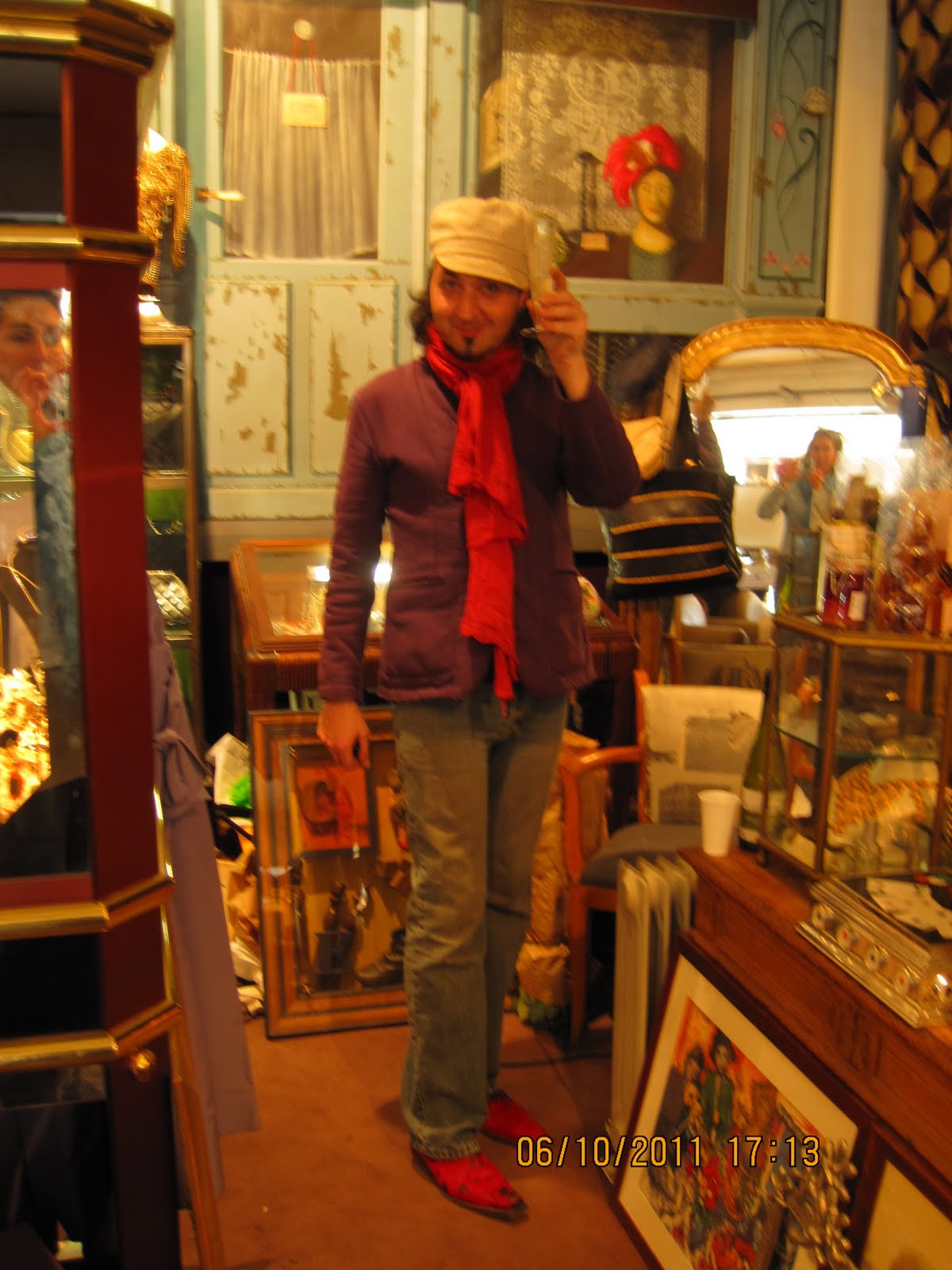
Judy, Lynn, Theresa and I then shopped the consignment stores and flea market while I purchased two pairs of earrings for 5 Euros.  Bargain right?  Additionally, I met the fabulous Lawrence while shopping at the flea market.  I've purchased many a things from the Paris flea market but never came across the likes of Lawrence.  His boots were made of red Pony fur (from Italy according to Lawrence); his jacket was purple and he sipped champagne and offered me some while we looked at Channel and other notable items.  He was a true gentleman while wearing my favorite color combinations (see Lawrence below).

Friday, June 10, 2011

Sur Le Canal Saint Martin

Today, Friday, I took a Canal and Seine River tour.  It poured rain and the window leaked but I learned a lot about the canals and neighborhoods.  Highlights include:
  • Napoléon ordered the construction of the Canal Saint-Martin in 1802. It was originally built to link to the Canal de l'Ourq, further north, to supply fresh water to the city.
  • In the 19th century, the area was mostly occupied by working-class laborers. Only recently has it started to attract well-to-do professionals eager to snag apartments with views of the canal.
  • The canal and its surroundings were entirely reconstructed on set for Marcel Carné's 1938 film, Hôtel du Nord.
    Gate closed and water returning to origin.
    Guys working out in the rain.
    Once the canal doors shut, the water level reduces to the next water level below.
    Canal
    
    Notre Dame

    After the canal ride, I walked home in the rain, caught a chill and thought I'd need to warm up in the shower, but as luck would have it the sun came out.  When I arrived home I thought it time to snap a couple of pictures of the Statue of Libery Paris style, as well as the proximity of the Eiffel Tower to the Grenelle apartment.  Some historical information about the Statue of Liberty is described below.


    Statue of Liberty Commentary

    "The Statue of Liberty National Monument officially celebrated her 100th birthday on October 28, 1986. The people of France gave the Statue to the people of the United States over one hundred years ago in recognition of the friendship established during the American Revolution. Over the years, the Statue of Liberty has grown to include freedom and democracy as well as this international friendship.
     
    "Sculptor Frederic Auguste Bartholdi was commissioned to design a sculpture with the year 1876 in mind for completion, to commemorate the centennial of the American Declaration of Independence. The Statue was a joint effort between America and France and it was agreed upon that the American people were to build the pedestal, and the French people were responsible for the Statue and its assembly here in the United States. However, lack of funds was a problem on both sides of the Atlantic Ocean. In France, public fees, various forms of entertainment, and a lottery were among the methods used to raise funds. In the United States, benefit theatrical events, art exhibitions, auctions and prize fights assisted in providing needed funds. Meanwhile in France, Bartholdi required the assistance of an engineer to address structural issues associated with designing such as colossal copper sculpture. Alexandre Gustave Eiffel (designer of the Eiffel Tower) was commissioned to design the massive iron pylon and secondary skeletal framework which allows the Statue's copper skin to move independently yet stand upright. Back in America, fund raising for the pedestal was going particularly slowly, so Joseph Pulitzer (noted for the Pulitzer Prize) opened up the editorial pages of his newspaper, "The World" to support the fund raising effort. Pulitzer used his newspaper to criticize both the rich who had failed to finance the pedestal construction and the middle class who were content to rely upon the wealthy to provide the funds. Pulitzer's campaign of harsh criticism was successful in motivating the people of America to donate.

    "Financing for the pedestal was completed in August 1885, and pedestal construction was finished in April of 1886. The Statue was completed in France in July, 1884 and arrived in New York Harbor in June of 1885 on board the French frigate "Isere" which transported the Statue of Liberty from France to the United States. In transit, the Statue was reduced to 350 individual pieces and packed in 214 crates. The Statue was re-assembled on her new pedestal in four months time. On October 28th 1886, the dedication of the Statue of Liberty took place in front of thousands of spectators. She was a centennial gift ten years late.

    
    Grenelle Apartment Building
    
    Proximioty of Eiffel Tower from Grenelle...three blocks!


Ekkehard and Mak (the cat) came over on their way to the countryside.  We discussed some metro routes for the flea market tomorrow before he tackled the traffic out of the city.  Meanwhile, Jude cooked up another one of her delicacies and here I am typing my blog sipping a glass of vin...Bon Soir!